


Recently, I came across a brilliant comic that completely changed how I look at beliefs. I highly recommend checking it out—it’s called “How to Change Minds” by Rebecca Fox, and so far I consider it to be one of the best metaphorical depictions of dogmatism I’ve come across.1
The comic is narrated by Anthony Magnabosco, Executive Director of Street Epistemology International. Now let’s pause for a second. What exactly is Street Epistemology? First, we have to start with “epistemology,” a word that looks rather esoteric, but thankfully doesn’t have to be. It’s really just the branch of philosophy that studies knowledge. You can think of epistemology as dealing with the very foundations of philosophical frameworks from which philosophers construct their theories. So Street Epistemology (SE) can be thought of as a conversational framework that explores why people believe what they believe. It also so happens that SE is an exceptionally powerful tool for changing people’s minds.
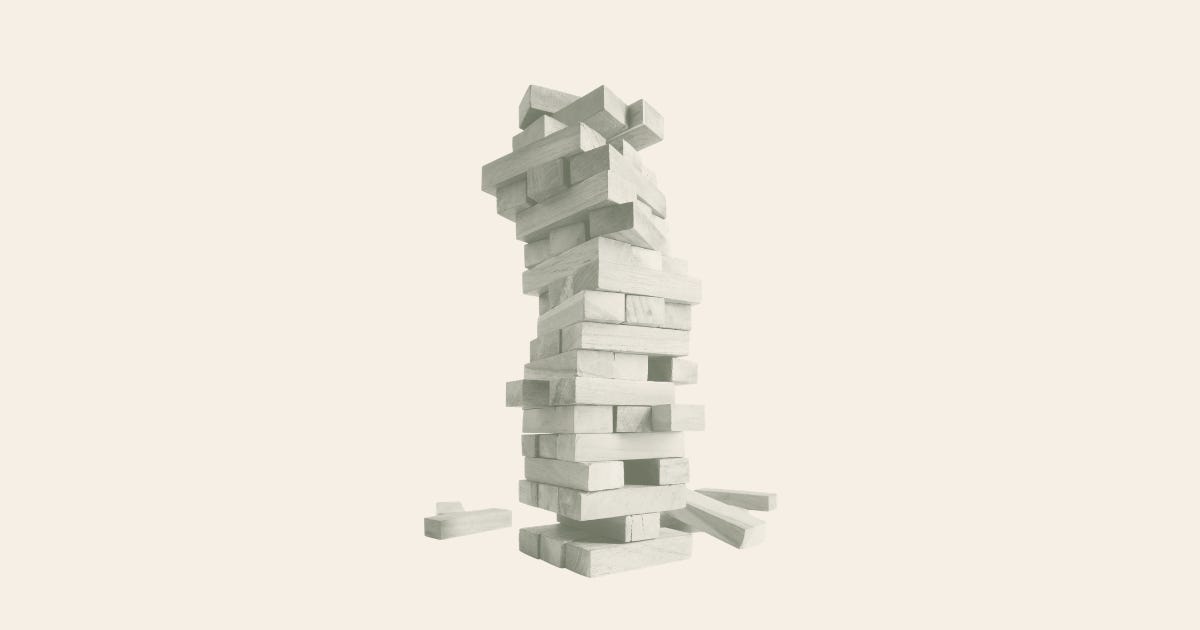
In her comic, Fox calls us to imagine ourselves walking around with towers of beliefs stacked on our heads. Though we’re not always conscious of these towers, we’re always meticulously guarding them so they don’t topple over. Some of us have towers that are so perilously tall that we’re afraid to move, while others seem to possess the talent for keeping their towers steadily balanced. Reflecting on this, I am reminded of my Protestant upbringing. I recall how I was taught to safeguard my beliefs and shun doubt through what I at the time called “faith” (but now call making baseless assumptions). Though I took pride in how diligently I balanced my tower, I couldn’t see how vulnerable it was to the risk of being knocked over—until it actually happened.
The comic presents other examples. It shows how some of us are reckless, constantly losing blocks and picking up new ones in their place. I find this was the case for me in my college years, when I abandoned Christianity and started cycling through various spiritual practices and traditions. I wanted to try the whole spiritual buffet, and found I often had to purge myself of several blocks to make room for new ones. Though this helped me get more comfortable with changing my mind, I now see that I was merely replacing one set of dogmas with another.
Fox continues to illustrate that some people have constructed towers so high that they can’t enter rooms. It’s easy to see how this metaphor applies to the significant political polarization we experience today. We aren’t talking to each other because we despise towers that differ from our own. Not only do the towers we carry bar us from entering these rooms, but they also keep us stuck in our own rooms—stifling any hope that we will get those who think differently from us to build towers similar to our own.
In the same vein, Fox illustrates those who have towers just tall enough to ride the ride they want to ride. Here we can imagine the “rabbit hole” of echo chambers that indoctrinate people into cultlike thinking. Though these towers are tall enough for the ride, we find that the ride itself is unsafe and at risk of malfunction, accidents, or worse.
The last tower structure that Fox introduces is the version that Street Epistemologists want us to build—the short and sturdy ones. She wholesomely depicts the people carrying these kinds of towers dancing around without fear of their blocks falling. But what prevents us from constructing these short towers? Fox introduces two unpleasant characters: the Prince and the Beast.
The Prince, according to Fox, “guards the tower with wit, eloquence, and charm.” He is a master of misdirection, and when someone gets too close to the tower, he seeks to distract them. If cornered, he might even give up a few top blocks to retain the overall structure of the tower. The Prince seems to represent the dishonest tactics we use to guard our dogmatic beliefs. We find that though he comes across as clever, charismatic, and convincing, the Prince deep down is a con artist. We find him in every grifter, quack, demagogue, and cult leader we encounter.
At the base of our towers is the Beast, who “is always ugly and always scared,” according to Fox. He guards the foundational blocks, and will not under any circumstances let you take those blocks. He fears that losing those bottom blocks will result in a loss of identity, livelihood, and connection to loved ones. So when those blocks become threatened, the Beast resorts to anger and violence. We see this notably in cases of violent extremism—each fueled by a Beast whose bottom blocks felt jeopardized.
Fox cautions that if we want to change someone’s beliefs, we must confront their Prince and their Beast. But doing this poses several risks. If you’re fortunate, you’ll encounter their Prince, who will attempt to disarm you. But if you’re unfortunate, you’ll suffer the Beast’s fury. The comic reminds us that, despite these threats, the Prince and the Beast just want to keep their host safe. This helps us avoid assuming bad intentions, as supposing this can quickly derail the discussion. But despite seemingly good intentions, it helps to remind ourselves that these blocks are mind viruses, and that the Prince and Beast are ultimately keeping their hosts sick. But is there a way we can administer a cure without drawing attention from these characters?
Perhaps you’re quick enough to pull out a few loose blocks. In some of these cases, you might even be thanked for lessening the load, but if you’re not careful, the Beast will lash out at you. Another risk to consider is that you may carelessly choose the wrong block, causing the tower to collapse and leave behind a cataclysmic mess. Doing this could even hurt someone in the process. Fox tells us “either way, rooting around inside someone’s head while they’re not looking seems kinda rude.”
Street Epistemologists find that the best way to change other people’s minds (or even your own), is not through prying out individual blocks, but through first acknowledging the tower, and then asking sincere questions that the Prince and the Beast aren’t guarded for such as:
“How did you build that?”
“Why did you build that?”
“What’s keeping that up?”
Questions such as these seem to be at the root of Pyrrhonism, which to me is no surprise. Not only is Pyrrhonism largely relevant to contemporary epistemology, but it also involves a philanthropic approach to changing minds referred to as the “cure by argument” (name look familiar?).
Like Street Epistemologists, Pyrrhonists examine beliefs through continued inquiry. The very beginning of Outlines of Pyrrhonism opens with Sextus Empiricus describing a Pyrrhonist as someone who hasn’t found the truth but continues to search for it. Not only does a Pyrrhonist investigate claims, but they also investigate the justification for these claims. Questions such as the three examples listed above examine whether we’re justified in building the towers we’ve constructed.
By abandoning adversarial thinking in favor of collaborative thinking, Fox says we’re able to talk to and connect with the person themselves, bypassing their Prince and Beast in the process. We also connect with the person and learn more about them when we do this. We learn, for instance, that they chose their higher up blocks because they made them feel good. Or perhaps they just happened to be lying around. You might even discover that they didn’t choose their bottom blocks at all, and that those foundational beliefs were placed there by their parents, society, or culture. When we learn how different towers are built, we’re not only more likely to succeed in helping others deconstruct them, but we’re also able to step back to examine our own beliefs.
Toward the end of her comic, Fox considers that it would “be a lot easier to get by with a shorter tower made of beliefs we consciously chose because we had solid evidence to support them.” Here is an area where I think Pyrrhonism can go much further than SE.
For starters, what can we say should serve as a Pyrrhonist’s foundational blocks? From one angle, we could say appearances. Verily, it seems we all accept that what appears to us appears to us. I can say, for instance, that it appears to me that I am writing an essay. If I were to deny this, I would either be lying or gaslighting myself. But what I am unable to do is make claims about the nature of what appears to me, such as whether this essay objectively exists, or whether it’s a good one. Such claims are considered dogmatic to a Pyrrhonist.
But as we can see above, Fox is encouraging us to build towers using beliefs we consciously chose, and as Sextus tells us in Outlines (1.13), appearances are forced upon us. Nobody chooses to assent to appearances because assenting to appearances is not a choice. Therefore Pyrrhonism takes us deeper than Street Epistemology by undermining any criteria that would result in us choosing to believe in something.
Pyrrhonists aren’t blockheads. We see that carrying a tower of blocks on our heads not only makes us look silly, but it also makes us sick. We recognize that these towers are illnesses, and that it is through curing by argument that we can purge ourselves of dogmatism. I find that Street Epistemology is incredibly useful for this, and several other Pyrrhonists have told me they also find it useful. Perhaps through these methods, we can run the Prince and the Beast out of their jobs once and for all, and liberate our minds from the trickery and fear that keep us bound to dogmatism.
Another helpful metaphor is the depiction of dogmatism as a “mind virus,” which I also mention in this essay.